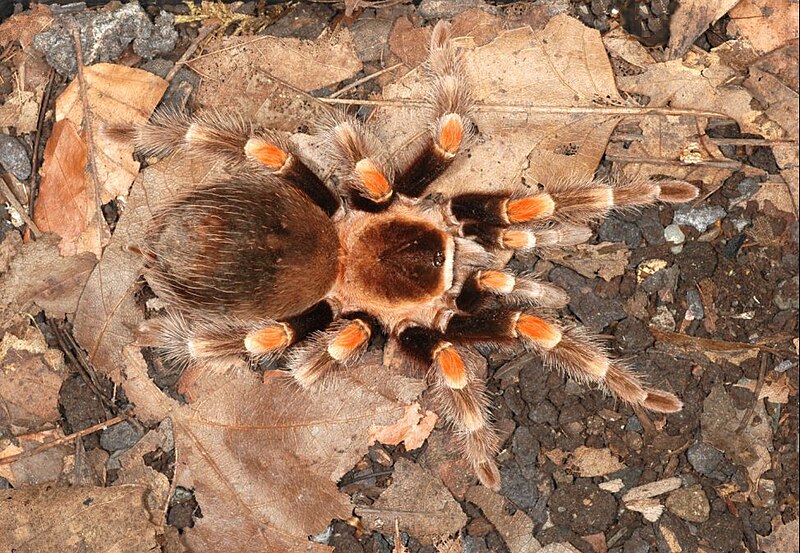
7 Facts About Tarantulas To Amaze You

Credit : Wikimedia Commons
The tarantula's appearance is worse than its bite. Tarantula venom is weaker than that of a honeybee and, though painful, is virtually harmless to humans.

Tarantulas periodically shed their external skeletons in a process called molting.

Tarantulas have an average life span of up to 30 years.

Tarantulas are accomplished nocturnal predators. Insects are their main prey, but they also target bigger game, including frogs, toads, and mice. The South American bird-eating spider, as it name suggests, is even able to prey upon small birds.

Generally tarantulas are burrowers that live in the ground. A tarantula does not use use a web to trap their pray. Instead they grab their pray using with their appendages and inject a paralyzing venom using their fangs.

A tarantula's venom contains digestive enzymes that dissolve their victims body so that they can suck them up through their straw-like mouth. 

Parasitic pepsis wasps are known to paralyze a tarantula with its sting and lay its eggs on the spider's body. When the eggs hatch, wasp larvae gorge themselves on the still living tarantula.

Read More at the Nat Geo Website

Comments

Popular posts from this blog

General Knowledge Quiz 5

1.  Who was the first woman to become the Air Marshall of the Indian Air Force? Answer: Padmavathy Bandopadhyay Show Answer 2.  Name the author of the books "Audacity of Hope" and "Dreams From my Father" Answer: Barrack Obama. Show Answer 3. By whom was the telescope invented? Answer: Hans Lippershey Show Answer 4.  Who was the first Indian to win the Booker Prize? Answer: Arundhuti Roy for her book "The God of Small Things". Show Answer 5.  Who was the first woman to summit the Everest? Answer: Junko Tabei of Japan. Show Answer 6. Identify the american painter famous for his 'drip painting' technique. Answer: Paul Jackson Pollock. Show Answer 7. Who is the author of the book "The Museum of Innocence? Answer: Orhan Pamuk. Show Answer 8. Name the capital city of the erstwhile 'West Germany? Answer: Bonn. Show Answer

General Knowledge Quiz 1

1. Which is the world's most venomous snake? A. Black Mamba B. King Cobra C. Taipan D. Russell's Viper Answer: Black Mamba Show Answer 2. What is the study of inland water-bodies known as? A. Ontology B. Lintology C. Limnology D. Marine Biology Answer: Limnology. Show Answer 3. What is the chemical name of water? A. Oxi-hydrogen B. Hydrogen Oxide C. Oxidised Hydrogen D. Dihydrogen Monoxide Answer: Hydrogen Oxide Show Answer 4. Who is credited with the invention of the safety pin? A. Walter Hunt B. David Bushnell C. Isaac Singer D. M Lammond Answer: Walter Hunt Show Answer 5. What is used in solar cells to convert sunlight into electricity. A. Zircon crystals B. Quartz C. Silicon Crystals D. Hydrogen Peroxide Answer: Silicon Crystals Show Answer

Interesting Facts About Bats

Human civilization has generally regarded bats with superstition, fear and uncertainty. This post attempts to bring out some of the true facts about this amazing mammal.  Bats are found throughout the world except for certain oceanic islands, the Arctic and Antarctic.  Bats are the only mammals that can fly.  There are more than a 1000 bat species in the world.  More than 25% of the total number of mammal species are species of bats.  In colder regions, bats either hibernate in shelters with high humidity and temperatures above freezing, or migrate to warmer areas.  Bats are not blind.  Bats are very sociable animals, live in large colonies and communicate with each other.  Bats emit a series of supersonic cries and are able to detect flying insects when these sounds are reflected back (upon their contact with the insect's body). This is known as Echolocation  Echolocation also gives them a general se...